
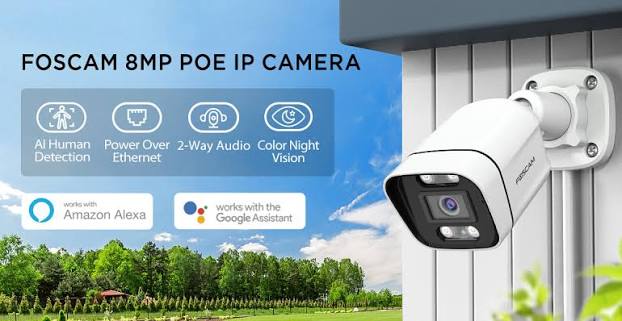
Resolution sells cameras, but resolution alone does not make a good system. A 4K PoE IP camera can give you evidence-grade detail with a single cable, yet only if the lens, storage and network are set up properly. Here is a plain-language guide to picking the right one and avoiding the usual headaches.
What 4K actually means
A 4K camera is an 8-megapixel camera. Its image is roughly 3840 by 2160 pixels, which is about four times the detail of a 1080p camera. More pixels mean you can zoom into recorded footage and still read a shirt logo, a delivery label or the color of a car. For a parking lot, a retail floor or a front entrance, that extra detail is often the difference between useful footage and a blurry guess.
Why PoE makes life easier
PoE, or Power over Ethernet, sends power and video through a single network cable. That means no separate power adapter at every camera, a cleaner installation and fewer points of failure. You also get the option to run the whole system from one UPS, so cameras keep recording during a short power cut.
A few practical limits to remember:
- A standard network cable run should stay within 100 meters (about 328 feet)
- Check the PoE budget of your switch or NVR. Add up what each camera draws, then leave some headroom
- Use proper Cat5e or Cat6 cable, not cheap copper-clad cable, which causes random drop-outs
Specs that matter more than the megapixel number
Two 8MP cameras can perform very differently. Look at these details before you decide.
Lens. A 2.8mm lens gives a wide view. Worldstar’s 4K bullet cameras, for example, offer a field of view around 112 degrees, which suits entrances and open areas. Longer lenses reach farther but cover a narrower scene.
WDR (wide dynamic range). If your camera faces a bright window or a sunny gate, true WDR keeps both bright and dark parts of the image readable. A figure around 120dB is a strong sign.
Night vision. Smart IR keeps faces from washing out by adjusting the infrared power. A range of about 30 meters (98 feet) is common on bullet and turret models.
Compression. H.265+ compresses video far better than older H.264. That saves hard drive space, which matters a lot at 4K.
Durability. IP67 means the housing handles heavy rain and dust. IK10 means it can take serious impact, which is useful where someone might swing at it.
Storage and bandwidth: do the math
4K files are large. Depending on scene activity and settings, a single stream often lands in the range of 4 to 8 Mbps with H.265+. Multiply that by the number of cameras and the days of footage you want to keep, and you will see why storage planning matters. A few ways to keep costs sensible:
- Use motion or event recording on low-traffic cameras
- Run a lower frame rate on cameras that do not need smooth motion
- Choose an NVR that supports 8MP channels and enough drive bays
- Use surveillance-grade hard drives, not desktop drives
Bullet, turret or dome?
Bullet cameras are easy to aim and good for long, narrow views like fences and driveways. Turret cameras avoid IR reflection problems because there is no dome bubble, so they work well under eaves and in tight spaces. Domes look tidy indoors and hide where the lens is pointing. Vandal domes add protection in public areas.
Common buying mistakes
- Buying 4K cameras but connecting them to an NVR that only records 4MP or 5MP
- Ignoring bandwidth, which leads to choppy live view
- Putting a bright-light-facing camera on a wall without checking WDR
- Skipping the night-time test before final mounting
- Assuming 4K fixes a bad camera angle (it does not)
Is 4K always the right choice?
Not always. For a small indoor room, a 4MP camera may be plenty and will save storage. But for entrances, cash areas, license plates, yards and long perimeters, a 4K PoE IP camera earns its price quickly because you can crop in without losing the detail you need.
Final thoughts
Choose the camera based on the scene, not the spec sheet alone. Match the lens to the distance, check WDR for tough lighting, plan your storage, and make sure your switch and NVR can handle the load. Do that, and a 4K PoE IP camera will give you clear, reliable footage for years. Compare 8MP bullet, turret and dome options in our network camera range and filter by resolution to find the right fit.
