
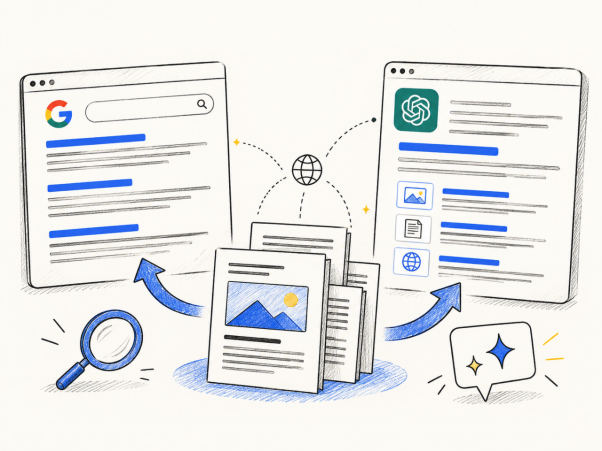
Why does ChatGPT SEO need its own playbook? Because ChatGPT does not return a ranked list of links. It builds one answer and cites a handful of sources, and those sources do not line up neatly with Google’s results. The short answer for B2B SaaS teams is that ChatGPT SEO builds on Google SEO instead of replacing it. You still need strong, crawlable content, but you also need to let OpenAI’s crawler in, cover topics thoroughly, and measure citations as well as rankings.
What Is ChatGPT SEO?
ChatGPT SEO is the practice of making your content easy for ChatGPT to find, understand, and cite when someone asks a question. You will also see it called GEO or AEO, which stand for generative engine optimization and answer engine optimization. The goal is to be named or linked in the answer, not just to rank on a results page.
How ChatGPT Finds Sources
When ChatGPT searches the web, it does not run a single lookup. Grow and Convert’s study of 100 buying-intent prompts found that ChatGPT breaks a prompt into two to four smaller “fan-out” searches. It also found that 83 of the 100 prompts triggered a web search at all, which means ChatGPT answered 17% of them without searching. Whether your pages are retrieved therefore depends on both whether it searches and what it searches for.
ChatGPT SEO vs Google SEO: Key Differences
| Factor | Google SEO | ChatGPT SEO |
| Output | A ranked list of links | One composed answer with a few citations |
| Crawler | Googlebot | OAI-SearchBot for search features |
| Success metric | Rankings, clicks | Citations, mentions, recommendations |
| Predictability | Fairly repeatable | Varies by prompt, user, and run |
| Content that works | Helpful, well-structured pages | Largely the same, plus topic depth |
What Does the Evidence Say About Rankings and Citations?
Many teams assume that ranking on Google guarantees a ChatGPT citation. The data suggests the connection is real but loose.
Ranking Helps, but It Does Not Guarantee a Citation
Grow and Convert compared the sources ChatGPT cited against Google and Bing results for each fan-out query in a study of 100 buying-intent prompts. Only 27% of cited sources ranked on Google for those queries, and only about 40% appeared in the first ten pages of either Google or Bing. That leaves roughly 60% that did not. Overlap varied widely: 20 prompts had no cited source in the results, and only one prompt had full overlap.
The same study found that when it counted any page from a cited domain, instead of the exact URL, the Google match rate rose from 27% to about 50%. That hints that ChatGPT may favor domains with broad coverage of a topic, though the authors treat this as a theory. It is a small, single-source study, so treat the numbers as directional. Other studies have reported anything from heavy overlap with Bing to light overlap with Google, which suggests ChatGPT draws on several sources.
Typical SEO Content Still Gets Cited
The same study found that 78% of cited sources were what you would expect from standard SEO work: list posts, product pages, homepages, and pricing pages. Even among sources that did not rank for the fan-out queries, the share stayed high at around 74%. In other words, ChatGPT is not rewarding a new kind of page. It is citing familiar kinds of pages, and the open question is which ones.
How Do You Make Your Site Eligible for ChatGPT?
Before content quality matters, ChatGPT has to be able to reach your pages.
Allow OAI-SearchBot
OpenAI’s crawler documentation explains that OAI-SearchBot is the crawler used to surface sites in ChatGPT’s search features. Sites that opt out of it will not be shown in ChatGPT search answers, although they can still appear as navigational links. OpenAI recommends allowing OAI-SearchBot in your robots.txt file. The settings are independent, so you can allow OAI-SearchBot while blocking GPTBot, which is the crawler tied to model training. Changes can take about 24 hours to take effect.
Keep Pages Crawlable and Indexable
Make sure important pages return a normal response, are not hidden behind logins, and are not blocked by overly broad firewall or bot rules. Because studies disagree on how closely ChatGPT follows any single search engine, it is sensible to confirm that your pages are indexed in more than one.
How Do You Make Pages Worth Citing?
Access gets you into the pool. Content decides whether you are chosen.
Lead With the Answer
Open each page with a direct answer to the question in its title, then add detail. Clear, specific statements are easier for any system to quote than long introductions. Attribute numbers to their sources so claims can be checked.
Cover the Topic, Not Just the Keyword
Because ChatGPT explores several sub-questions per prompt, a single page rarely covers everything it looks for. A connected set of pages that answers the main question and its related questions gives you more chances to appear. This is the same logic behind topical authority, and it is consistent with the domain-level match pattern noted above.
Earn Mentions Beyond Your Own Site
ChatGPT’s answers draw on the wider web, so credible third-party coverage, reviews, and comparisons can matter as much as your own pages. Focus on being accurately described in places your buyers already read.
How Do You Measure ChatGPT SEO?
Traditional rank trackers will not show you this, so you need a different routine.
Track Prompts and Citations
Build a fixed list of buyer-intent prompts, such as “best tools for X” and “alternatives to Y,” and run them on a regular schedule. Record whether your brand is mentioned, which pages are cited, and how you are described. Expect variation between runs, since AI answers are not fully consistent. Some teams do this by hand, and some use AI visibility services such as GoBlinkly to monitor citations across several engines.
Watch Referral Traffic
Check your analytics for visits from ChatGPT and compare their behavior with organic search visitors. Volumes are usually small, so look at conversion and engagement as well as visit counts.
What Mistakes Should You Avoid?
The most damaging mistake is blocking the crawler by accident, often through old robots.txt rules or bot-management settings written when many sites were blocking AI bots. A second is chasing individual fan-out queries. Grow and Convert argues this is impractical, since you cannot see the true prompts users enter and fan-outs change, so broad topic coverage is the safer bet. A third is assuming citations are always accurate. That study found roughly 10% of ChatGPT’s citations pointed to error pages, so it is worth checking how you are described and where links lead.
Conclusion
ChatGPT SEO is best understood as Google SEO plus a few extra layers: crawler access, topic depth, quotable pages, and a new way of measuring results. Start by confirming that OAI-SearchBot can reach your site, keep publishing thorough content for the questions your buyers ask, and track citations on a regular schedule. Expect variation, and judge progress over months, not days.
Frequently Asked Questions (FAQs)
What is ChatGPT SEO?
ChatGPT SEO is optimizing your content and site so ChatGPT can find, understand, and cite it in answers. It is closely related to GEO and AEO.
Is ChatGPT SEO different from Google SEO?
They overlap heavily, since strong, crawlable, helpful content helps both. The differences are the crawler, the way answers are composed, and the metrics: citations and mentions instead of rankings and clicks.
How do I get my website cited in ChatGPT?
Allow OAI-SearchBot, publish thorough content that answers your buyers’ questions, cover your topic across connected pages, and earn accurate mentions on trusted sites.
Should I allow OAI-SearchBot?
If you want to appear in ChatGPT’s search answers, OpenAI recommends allowing it. You can block GPTBot separately if you do not want your content used for training.
Does ranking on Google guarantee a ChatGPT citation?
No. In the study above, most cited sources did not rank for the fan-out queries, although higher-ranking pages were more likely to be cited when overlap existed.
