
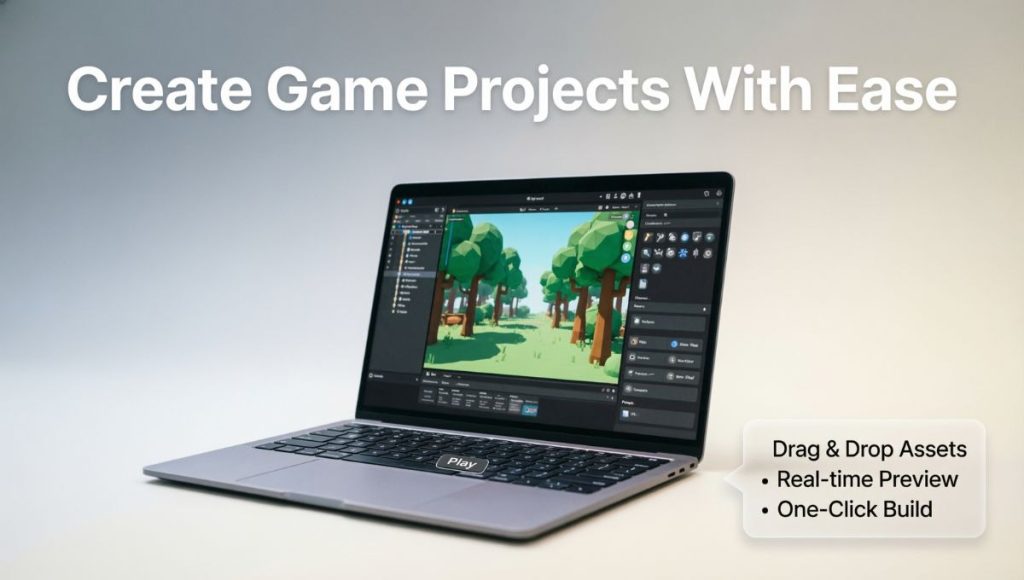
When we say make game projects easily, it just means that you can make your own game while feeling relaxed and at ease. It doesn’t mean you have to be a professional developer or a coding expert. A game project is often initiated from a minimal concept in your mind, and then you develop it into a playable form step by step. You define the rules, you define the characters, you define the objective, and you decide how the player will interact.
Students and beginners can now make game projects without feeling panic or confusion in this day and age. Truthfully, a lot of students do think game-making is that hard. I used to think that, too. When you do research online, you come across massive software names and daunting tutorials, and it’s intimidating. But as you start picking things up bit by bit, you understand it’s not as difficult as you’re going to think it is. One day, you’re not going to learn everything. You just need to get started somewhere.
It’s easier said than done, but the process becomes easier once you’ve stopped thinking so much and start doing. Keep things simple at the outset if you really want to be able to produce game projects easily. Start small rather than a big dreaming project. Platforms like Astrocade can allow novices to dip their toe into game building without overwhelming technical demands.
Smart Idea Planning
From a student’s perspective, planning is the most overlooked step in attempting to make game projects. Most of us just want to dive into designing characters or features. But without vision, the project turns into a mess. Before using any of the tools, it’s a good idea to write down your idea in your own words. What is the game about? What does the player do? How does the player win or lose?
When I think of game ideas clearly and explicitly on paper, it’s a whole lot neater. Keeping your yards small is also trite We don’t want to slate up our first game. A lot of beginners make the error of trying to create something really huge, and then they lose motivation halfway through. A short and simple game is ideal for learning. Having finished a project in one piece boosts your confidence automatically.
Beginner Friendly Tools
Lesson I learned after far too many game projects is that the right tool does a ton of work for you. Some platforms are too technical for novices, and they can make you feel like you’re stuck. That is also why students should seek out beginner-friendly software rather than software with complex dashboards and tutorials. Now, many more modern tools offer
drag-and-drop mechanics, letting you build pieces of your game without heavy coding. When you make game elements with easy tools, you’re wasting less time being creative and more time fixing technical problems. Better to pick a good platform and get some experience there rather than dabbling in a hundred. Learning becomes faster when you keep your eyes on the prize.
Creative Gameplay Design
In my opinion, the gameplay is more important than the graphics when filing game projects. You can have a game that looks simple and still is really fun. You just need to make sure the player knows what to do. The gameplay should be slick, and the objective should be obvious. When you design gameplay elements, you should always think like the player. Does it look like something that you’d like to play?
Even a tiny puzzle concept or running game can be made interesting if it feels right. A game such as ABC may not look high-tech, but if it is engrossing, that is what players will take away. The aim should always be fun and clarity, as opposed to complexity.
Visual Audio Enhancement
As a matter of fact, when you design game projects, visuals and sound are also necessary. But as a student, you don’t need expensive graphics. “Clear design,” readable text, and colors that go well together are suitable for a beginner project. When you think through your game scenes, they look more professional, even if they are simple.
Sound effects also help the experience. Small audio details, such as a click sound or background music, help make the game a little more complete. But it is important to get the balance right. Too many effects can make the game too heavy or distracting. Just keep everything simple and meaningful.
Testing Continuous Improvement
Testing is a lot of students ignore, but it is very important when you make game projects. Once you have built your game, play it over and over again. Look for errors or things that are unclear. Have your friends playtest it and be blunt in their feedback. There are sometimes issues that other people spot that you don’t.
When you implement game updates based on feedback, your project is that much stronger. Patch up minor bugs and tweak the difficulty as necessary. It’s a process of getting better, and every little change helps. Your skills will develop naturally in due course. Patience and creativity are all it takes to make game experiences that people actually enjoy.
Conclusion
You just need the right attitude and some basic instructions to make game projects with confidence. For example, have a clear vision for your game like Garden Gulp, use simple beginner-friendly tools for developing a game, and focus on fun gameplay game mechanics.
Consistency is key as a student. Keep experimenting and keep building those little projects. Platforms like Astrocade can make the path easier for newcomers. Your skills will develop naturally in due course. Patience and creativity are all it takes to make game experiences that people actually enjoy.
FAQs
How can a student create game projects easily?
A student can begin with a tiny idea and simple tools suitable for beginners. Learning step by step makes it easy to do. There are sometimes issues that other people spot that you don’t.
Do students need coding to create game projects?
Not always. Many platforms allow students to build games using drag-and-drop systems without advanced coding skills. You just need to make sure the player knows what to do
What is the first step to create game successfully?
The first step is planning your idea clearly. Writing down the concept helps avoid confusion later. Even a tiny puzzle concept or running game can be made interesting if it feels right.
As a newbie, how long does it for making game?
That really depends on the scale of the project. A modest student project can be done in a few weeks with consistent effort.
What should I do to better my skills for making game projects?
Playtest a lot, learn from your players, and listen. Every project makes you better. Most of us just want to dive into designing characters or features.
