
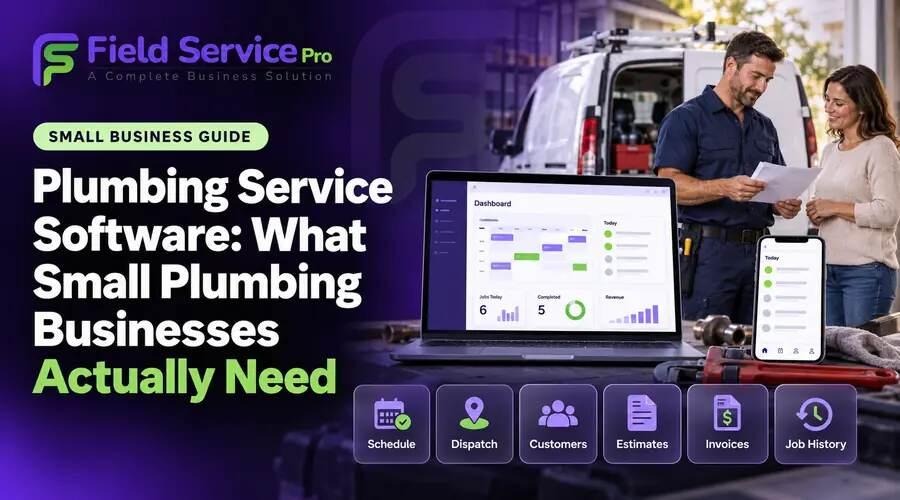
Most articles about plumbing software are written for companies with twenty trucks and a dedicated office manager. But if you’re running a small plumbing business, maybe two or three technicians, maybe just you and a helper, your needs look completely different. You don’t need a system built for a big operation. You need something simple that saves you time today, not a tool that takes three months to learn.
This guide is written for that reality. What actually matters when a small plumbing business is choosing plumbing CRM software, and what you can safely ignore.
Do Small Plumbing Businesses Really Need Software, or Can a Notebook Still Work?
A notebook and a phone calendar can work for a while. Plenty of one-truck operations run that way for years. But there’s a point where it starts costing you money without you realizing it.
That point usually looks like this:
- You forget to invoice a customer for two weeks because the job slip got buried under other paperwork.
- A customer calls asking about a warranty on a water heater you installed, and you can’t remember the install date.
- You double-book a Tuesday afternoon because you wrote the appointment on two different pieces of paper.
None of these are big disasters on their own. But add them up over a year, and they represent real money left on the table and customers who quietly go elsewhere next time. Plumbing service software isn’t just about being “high-tech”, but not losing money to small, avoidable mix-ups.
What Do Small Plumbing Businesses Actually Need from Software?
This is the important part. Big companies need complex reporting dashboards and multi-location management. Small plumbing businesses need a simple plumbing field service software, which is much more basic and can be used easily.
- A Simple Way to See the Day’s Jobs
You need to open your phone in the morning and know exactly where you’re going, in what order, and what each job is about. That’s it. Not a complicated dashboard with fifteen tabs, just a clean daily view.
- One Place for Every Customer
Every customer you’ve ever done a job for should be searchable in seconds, by name, phone number, or address. Their job history, what you charged, what parts you used, should all be right there. This alone saves an enormous amount of back-and-forth, especially when a customer calls back six months later about the same issue.
- Invoicing You Can Do From the Job Site
Small plumbing businesses lose more money to slow invoicing than almost anything else. If you’re still writing paper invoices and mailing statements, you’re often waiting three to four weeks to get paid for work you did in an afternoon. Software that lets you invoice and collect payment before you even leave the driveway changes your cash flow completely.
- Estimates That Don’t Take an Hour to Put Together
When a customer asks “how much will this cost,” you want to give them a real, professional-looking number in a few minutes, not go back to the office and type something up later when the moment has passed and they’ve already called someone else. This can only be possible through a plumbing estimating software.
- Something Your Helper or New Hire Can Learn in a Day
This one gets overlooked constantly. Small businesses can’t afford software with a steep learning curve. If it takes a week of training for a new technician to use it comfortably, it’s the wrong tool, no matter how many features it has.
Why Does a CRM Matter for a Small Plumbing Business Specifically?
A CRM sounds like something only big companies need, but it might matter more for small businesses, not less. A large company can absorb a mistake, like forgetting to follow up with a customer, because volume covers for it. A small business can’t. Every single customer relationship matters a lot more when you have fewer of them.
A CRM for plumbers keeps track of things you’d otherwise have to remember in your head: who’s due for a maintenance check, who mentioned they’re planning a bathroom remodel next year, who still owes a callback because a part had to be ordered. For a small business, this turns into real repeat work and referrals, which are usually the lifeblood of a plumbing company that doesn’t have a big advertising budget.
It also makes your business look more established to customers. When a plumber shows up already knowing the history of the property and greets you by name instead of asking “what did we do here last time,” it builds trust fast. That trust is often the reason a customer calls the same company again instead of shopping around.
What Should a Small Plumbing Business Avoid When Choosing Software?
Just as important as knowing what to look for is knowing what to skip.
- Avoid tools built for huge fleets: If a product’s marketing talks constantly about managing hundreds of technicians across multiple regions, it’s probably going to be overloaded with features you’ll never touch, and priced accordingly.
- Avoid long-term contracts before you’ve tested it: A small business needs flexibility. Look for month-to-month options so you’re not stuck if the tool doesn’t fit.
- Avoid anything that isn’t mobile-friendly: If you or your technician can’t run the whole day from a phone, the software isn’t built for field work, it’s built for an office that a small plumbing business often doesn’t have.
- Avoid overpaying for reporting you won’t use: Advanced analytics sound nice, but if you’re a two-truck operation, you probably just need to know which jobs made money and which customers pay late. Simple beats fancy here.
How Do You Know When It’s Time to Switch to Real Software?
A few honest signs it’s time to move on from notebooks and spreadsheets:
- You’ve missed sending an invoice at least once in the past few months
- You or your office person spends more than a couple hours a week just organizing schedules
- You’ve lost track of a customer’s history and it showed in front of them
- You’re turning down jobs because you’re not confident you can keep track of them all
If any of that sounds familiar, the cost of switching to real plumbing service software is almost always smaller than the cost of continuing to lose time and money to disorganization.
Why FieldServicePro Fits Small Plumbing Businesses So Well
This is exactly why FieldServicePro was built the way it was. It focuses on what small plumbing businesses actually use every day, such as a clean daily schedule, a full CRM that remembers every customer and job, invoicing and payments you can do right from the job site, and quotes you can send in minutes, all from a phone.
There’s no steep learning curve, no bloated dashboard, and no long contract holding you hostage if it’s not the right fit. It’s built so a two-person plumbing crew can look as organized and professional as a company ten times its size, without needing an office manager to run it.
The Bottom Line
Small plumbing businesses don’t need complicated software. They need the right basics done well – organized scheduling, a CRM that remembers every customer, fast invoicing, and quotes that go out quickly. Get those right, and the rest of the business runs a lot smoother. FieldServicePro was built with exactly that in mind, giving small plumbing companies the tools to grow without the complexity that usually comes with them.
